


Derailed at York

Gillingham’s winning run ends abruptly as York provide an uncomfortable benchmark
Originally published in Gills Journal by David Tickner.

Gillingham’s three-match League Two winning run ended emphatically on Saturday as York City won 3–0 at the LNER Community Stadium.
It is tempting to blame two more first half injuries – Will Goodwin and Eli King who both required replacement - and the dismissal of Zane Albarus in the 70th minute with the score still at 1-0. They certainly made an already challenging opponent more difficult and perhaps contributed to the margin of York’s superiority, but they weren’t the full story.
Leaving the ground at full-time, my overriding impression was not of a Gillingham side simply unfortunate to lose, but one that had been second best against a quicker, sharper and more coherent opposition.
York set the tone early
Right from the kick-off, York were more assured than Gillingham. They had more energy and inventiveness in midfield and regularly exposed Gillingham with balls through and over a defence that, on this occasion, looked slower and more vulnerable than in recent games.
With Gills starting uncertainly, York keeper, Alfie McNally, played a long ball into the right-hand corner where the tricky Joe Felix got behind a hesitant Gills’ backline. Felix laid the ball back to Ollie Pearce, whose cross to the back post was met by Joe Grey. His right-footed effort struck the turf, bounced over Logan Dobbs and looped in slow motion into the far corner of the goal after just two minutes.
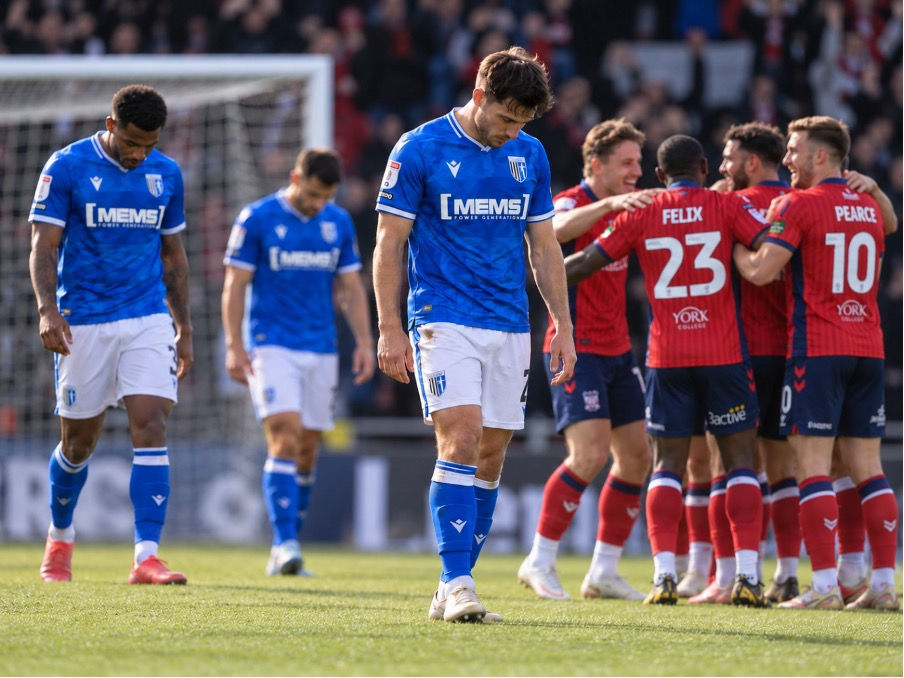
There were further first-half chances for Pearce, who was denied by Ollie Wright, while Alex Newby and Alex Hunt both struck the Gillingham woodwork. Had York gone in at the interval two or three goals to the good, it would not have been an injustice. Their dominance was reflected in ten first half goal attempts to Gillingham's two.
Second best – no excuses
Manager Gareth Ainsworth, while understandably pointing to the loss of King and Goodwin and the subsequent reduction to ten men, also acknowledged that Gillingham ‘weren't good’, conceded that York deserved their victory and concluded that ‘we were just second best today’. He attributed the defeat to individual errors, players being beaten off the ball, an inability to retain possession, poor passing and some players not fully understanding the formation concluding, ‘I've got legs, but I need nous as well’.
Speaking in measured tones shortly after the final whistle, Omar Beckles contrasted the identity York have established through several years of progress, culminating in promotion from the National League, with a newer and, in many cases, younger Gillingham squad in an earlier stage of its development.
Mind the doors
Characteristically, Ainsworth was ready to shoulder responsibility rather than simply blaming misfortune, his players or the referee. Gillingham did make a brighter start to the second half, with substitute Garath McCleary cutting in from the left and curling a right-footed shot narrowly wide. Ainsworth felt his side were beginning to put York under pressure and responded by altering the shape to make Gillingham more attacking. The sending-off disrupted that plan, prompting him to ask: ‘Did I get it wrong too?’
He had made only one change from the side that beat Bristol Rovers, with Will Goodwin replacing Lamin Sillah who had suffered a head injury in training. As a result, there was no recognised striker on the bench.
Further disruption followed before half-time. Goodwin was forced off after 19 minutes and replaced by Albarus, while King departed after 31 minutes, with McCleary taking his place. Afterwards, Ainsworth admitted his main concern was King, who missed almost all last season with an ACL injury.
Still in the game at 1-0 on 65 minutes, Ainsworth made further substitutions Bradley Dack for Ronan Hale who sustained a first half rib injury, Jack Daley for Andy Smith and Sheldon Kendall for Dobbs. However, even 32-year-old Dack, returning from injury, with all his club pedigree and status, but clearly lacking match sharpness, was unable to influence the game.
Albarus had been booked for a high challenge on Hunt in the 60th minute and received a second yellow card ten minutes later for a similar foul on Pearce. The young midfielder's dismissal owed much to his competitiveness and exuberance.
Soon after Albarus's dismissal, substitute Jovan Malcolm finally gave York the second goal their superiority merited, wriggling free of Daley before drilling past Wright. Four minutes later, Pearce's touch on Boyes' shot made it 3-0. James Brophy later struck the bar, but by then it amounted to little more than a consolation attempt.
A measure of the journey
After the defeat, both Ainsworth and his captain returned to the recent mantra: don't get too high, don't get too low. The visit to the LNER stadium need only prove a disappointing northern branch line diversion rather than hitting the buffers of a terminus at such an early stage in this season’s journey.
Ainsworth said people had told him York would be ‘a barometer of where we are’, questioned whether Bristol Rovers and Tranmere had not already been similar tests and warned against recent Gillingham sides going ‘off like a train and then fall(ing) away in a big way.’
Perhaps York was a barometer of how far Ainsworth's new side still need to travel to challenge consistently at the highest levels in League Two.
David Tickner writes regularly about Gillingham Football Club on Substack. You can read, follow or subscribe for free at Gills Journal | David Tickner | Substack.


Comments